By: Adam Cichy
How often is a product technically “in stock,” but still impossible for a customer to buy?
Inventory systems may show units available. The backroom may be full. But on the shelf where the customer expects to find the item, the facing is empty, misplaced, or replaced by something else. From the shopper’s perspective, none of that distinction matters. The product isn’t there. The purchase doesn’t happen.
That moment is often treated as an operational miss, something to correct through better processes or tighter execution. In practice, it is a revenue event. When a customer can’t find what they came for, the store risks losing the trip, the basket, and the trust that brings the customer back.
Availability Is a Revenue Signal
On-shelf availability is frequently tracked as a compliance metric. Teams measure whether stores are meeting planograms or maintaining expected stock levels, and the language tends to focus on execution quality.
The more relevant question is whether the customer can complete the purchase they intended to make.
When that doesn’t happen, the impact extends beyond a single SKU. A missing item can trigger substitution, often with lower margin. It can lead to partial baskets, where the shopper abandons items that depended on the missing product. In some cases, it results in a lost trip altogether.
Each of these outcomes represents revenue that could have been captured but wasn’t. The issue is visibility into on-shelf reality - not inventory counts.
The Gap Between Inventory and the Shelf
Most systems are designed to answer whether a product exists somewhere in the store. They rely on inventory data, replenishment logs, or periodic audits.
None of these reflect what the customer actually sees.
On-shelf availability breaks down in more subtle ways than simple stockouts. A facing may be empty even when inventory exists in the backroom. Items can drift out of their intended positions, creating confusion about where they belong. A product may be present, but blocked or obscured in a way that makes it effectively invisible.
Planograms provide a reference for how shelves should look, but they do not account for how conditions evolve throughout the day. Replenishment introduces lag, especially during high-traffic periods when demand outpaces restocking cycles.
The challenge is not counting units. It is understanding the state of the shelf as it exists in real time.
Seeing On-Shelf Reality Through Spatial Intelligence
Capturing that reality has traditionally required additional labor or specialized equipment. Manual audits provide snapshots, but they are intermittent and often outdated by the time they are completed. Dedicated shelf sensors or scanning systems add cost and complexity that limit scale.
A different approach starts with infrastructure that is already widely deployed.
We built our platform on computer vision and spatial intelligence, using existing camera systems to understand how physical environments operate in real time. While often associated with autonomous checkout, the same system continuously interprets what is happening across the store, including how products are positioned, interacted with, and depleted on shelves.
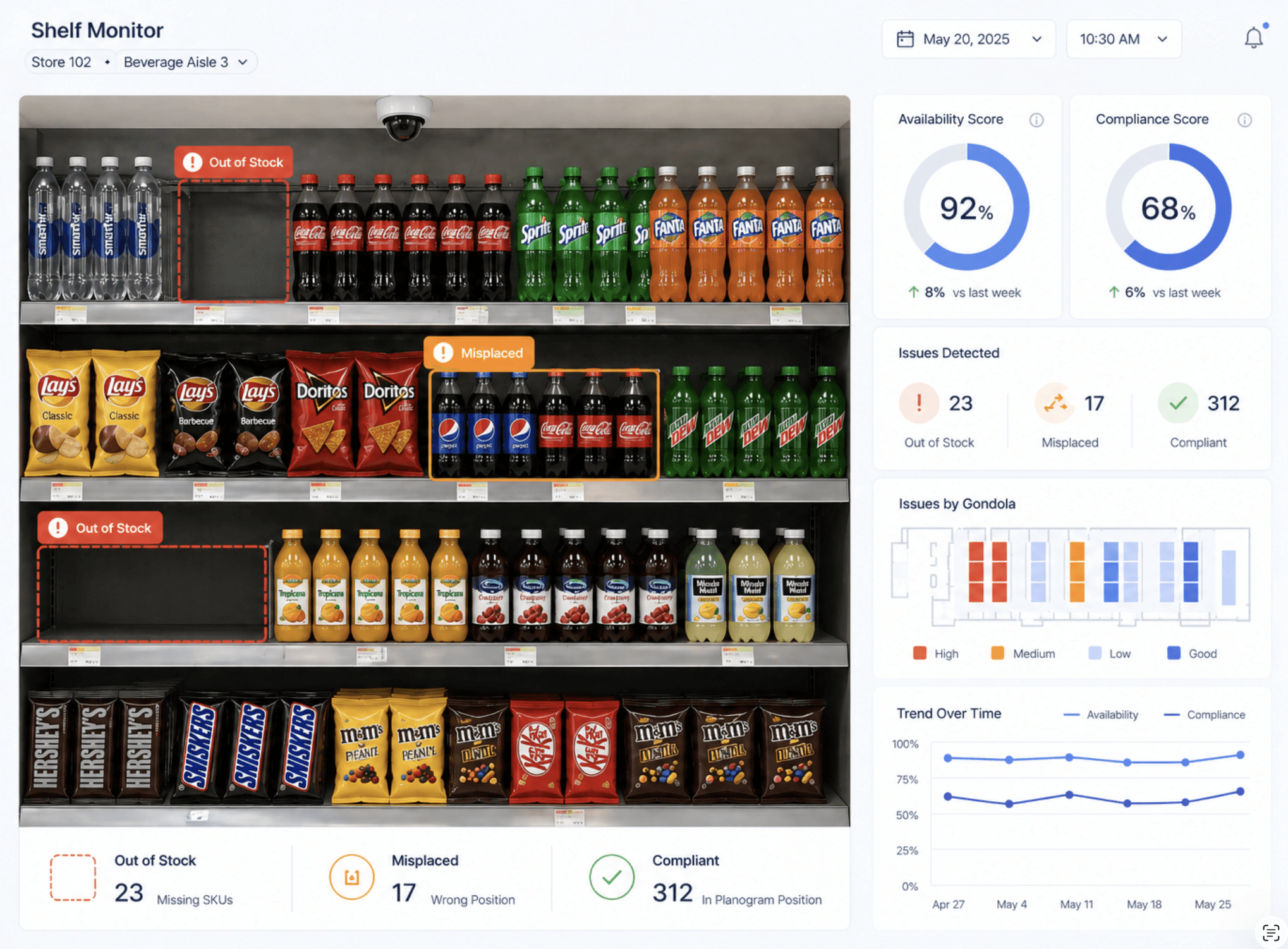
By observing shelf zones over time, the system can infer availability signals without requiring additional hardware or manual input. It detects patterns such as empty facings, misplaced products, or deviations from expected layouts, and translates those into availability confidence at the shelf or SKU group level.
This is a continuous view of what the shelf actually looks like from the shopper’s perspective.
Because the system is already reconstructing the store in 3D and tracking movement and interaction across space, availability becomes another layer of insight derived from the same foundation. No new installation is required. The visibility already exists and can be applied in this way.
From Visibility to an Actionable Queue
The most valuable output of that visibility is not a dashboard.
Retail environments generate more data than teams can realistically act on in the moment. Heatmaps and reports can show where issues exist, but they don’t answer the more urgent question: what should be fixed right now?
We intentionally choose to prioritize action over visualization. Instead of presenting a full map of availability across the store, the system surfaces a focused queue of the highest-impact issues at any given time. These are not generic alerts. They are specific, spatially grounded tasks tied to aisle and shelf locations, along with a confidence signal that reflects how likely the issue is to be real.
For example, a store team might receive a prioritized list of the top availability gaps currently driving the greatest revenue leakage, allowing them to move directly to resolution without needing to interpret a broader dataset.
This reflects a broader design principle within AiFi’s platform. Whether applied to checkout, shrink detection, or in-store operations, the goal is not simply to observe the environment, but to guide attention toward what matters while there is still time to act.
Closing the Loop Between Shelf Conditions and Shopper Behavior
Understanding what is happening on the shelf is only part of the picture. The full impact becomes clear when that signal is connected to how customers respond.
AiFi’s spatial intelligence platform already tracks shopper movement and behavior across the store, enabling a continuous view of the customer journey. When applied to availability, this makes it possible to observe not just that a shelf is empty, but what happens next.
A customer approaches a location expecting to find a product. They pause, search, scan adjacent shelves, and then make a decision. Sometimes they substitute. Sometimes they leave without purchasing. Sometimes they abandon the basket entirely.
By linking these behaviors to on-shelf conditions, operators can quantify the true cost of availability gaps. Revenue leakage is no longer inferred. It is observed as a sequence: search, failed find, substitution or abandonment.
This closes the loop between environment and outcome, turning availability into a measurable driver of revenue performance.
Measuring What Actually Changes
When availability is understood in this way, the metrics shift accordingly.
Operators can measure the percentage of time a shelf zone is effectively in stock from the shopper’s perspective, rather than relying solely on inventory status. They can estimate revenue leakage tied to availability gaps, track substitution rates, and understand how long it takes for shelves to be replenished once they become effectively empty.
Promotional performance can also be evaluated more accurately. A promotion tied to an item that is frequently unavailable on the shelf does not fail because of demand. It fails because the product is not accessible when the customer arrives.
These metrics move availability out of the realm of compliance and into the core of revenue and operational performance.
Availability as a Continuous Signal
On-shelf availability is often treated as a condition that is checked and corrected periodically. In practice, it is constantly changing as products move, customers interact with shelves, and replenishment cycles play out.
The platform is designed to operate within that continuous reality. By maintaining an up-to-date understanding of the physical environment, it allows teams to respond to availability issues as they emerge, rather than after they have already affected sales.
The shift comes from using existing visibility to understand the store as it actually functions, moment to moment.
From the customer’s perspective, availability is simple. Either the product is there, or it isn’t. When it isn’t, the opportunity is already gone.