An order is correct right up until the moment it isn't. It moves through the system cleanly at first, assembled step by step across stations that each handle a piece of the process. Then somewhere along that path, something small drops out. A sauce isn't added. A modification doesn't carry through. A drink never makes it into the bag. By the time anyone notices, the order is already in the customer's hands.
For years, the industry has explained these moments in the same way. Someone missed a step. Someone forgot. Someone wasn't paying attention. The assumption has always been that order accuracy is a function of individual performance, and the solutions have followed accordingly: more training, clearer checklists, tighter supervision. But if that framing were correct, error rates would have improved by now. They haven't, because the issue is not carelessness. It is the environment in which the work is happening.
The Hidden Cost Structure Behind "Small" Errors
The economics of the problem make it difficult to ignore. A missing sauce or forgotten add-on often costs only a few cents, yet the consequence rarely stays small. That same mistake can trigger a refund for the entire order, generate a complaint, and erode the likelihood that the customer returns. What begins as a minor omission quickly becomes a multi-dollar problem. The gap between the cost of the item and the cost of the error is where the issue lives, and it is largely invisible to the systems operators rely on today. Most tools capture the outcome, whether that is a refund or a complaint, but they do not capture the sequence of events that made the mistake likely in the first place.
Cognitive Load Is the Real Constraint
At the center of that sequence is cognitive load. In most professional environments, tasks are designed to limit how many variables a person must manage at once. In quick-service restaurants, the opposite is often true. Orders are assembled in parallel, not sequentially. Each one moves across multiple stations, with dependencies between them that shift in real time. The environment is loud, fast-paced, and constantly changing, especially during peak periods when demand compresses time and increases pressure.
Under those conditions, employees are expected to track order contents, timing, sequencing, and handoffs simultaneously. The number of variables they must hold in working memory is high, and it changes continuously as new orders enter the system. This is not a question of whether someone knows what to do. It is a question of how much they are being asked to manage at once, and how quickly those demands evolve. When viewed through that lens, errors are not surprising. They are predictable outcomes of an overloaded system.
The industry's response, however, has tended to move in the opposite direction. When accuracy declines, operators often add more process. Another checklist is introduced. Training modules are expanded. Performance monitoring becomes more visible. These interventions are intended to improve consistency, but they also add another layer of information that employees must track in an already saturated environment. They increase pressure at the same time that they increase expectations.
The research on cognitive load is consistent on this point. As pressure and oversight increase, accuracy tends to decline when individuals are already operating near their cognitive limits. What is intended as reinforcement becomes an additional burden. The system asks more of the same resource that is already constrained.
From Expectation to Detection
A more effective approach starts from a different premise. If the issue is not a lack of knowledge but a lack of cognitive capacity in the moment, then the solution is not to ask employees to remember more. It is to reduce the need for remembering altogether. That shift moves the focus from expectation to detection. Instead of relying on someone to track every component of an order, the system can identify when something deviates from the expected sequence and surface that signal while there is still time to correct it.
Timing is critical. An error that is detected after the order leaves the line becomes a customer service issue. The same error, identified before the bag closes or before the handoff occurs, remains an operational adjustment. The difference between those two moments is the difference between prevention and recovery.
To make that distinction actionable, it is necessary to observe the process itself, not just the outcome. Most restaurant systems are designed around endpoints. They measure whether an order was correct or incorrect, whether it was refunded or not. The more valuable signal sits in the middle, in how the order was assembled and where deviations occur within that sequence.
When that sequence becomes visible, patterns begin to emerge. Certain stations may be skipped more frequently during peak periods. Specific item categories, such as sauces or add-ons, may be missed at higher rates than others. Interaction patterns at one point in the workflow can correlate with errors that appear later in the process. In some cases, the issue is not the individual action at all, but an imbalance in staffing across zones that creates pressure in one area while another remains underutilized.
These are not isolated mistakes. They are repeatable behaviors that occur under specific conditions, and they become understandable only when the full process is visible.
Real-Time Visibility Changes the Outcome
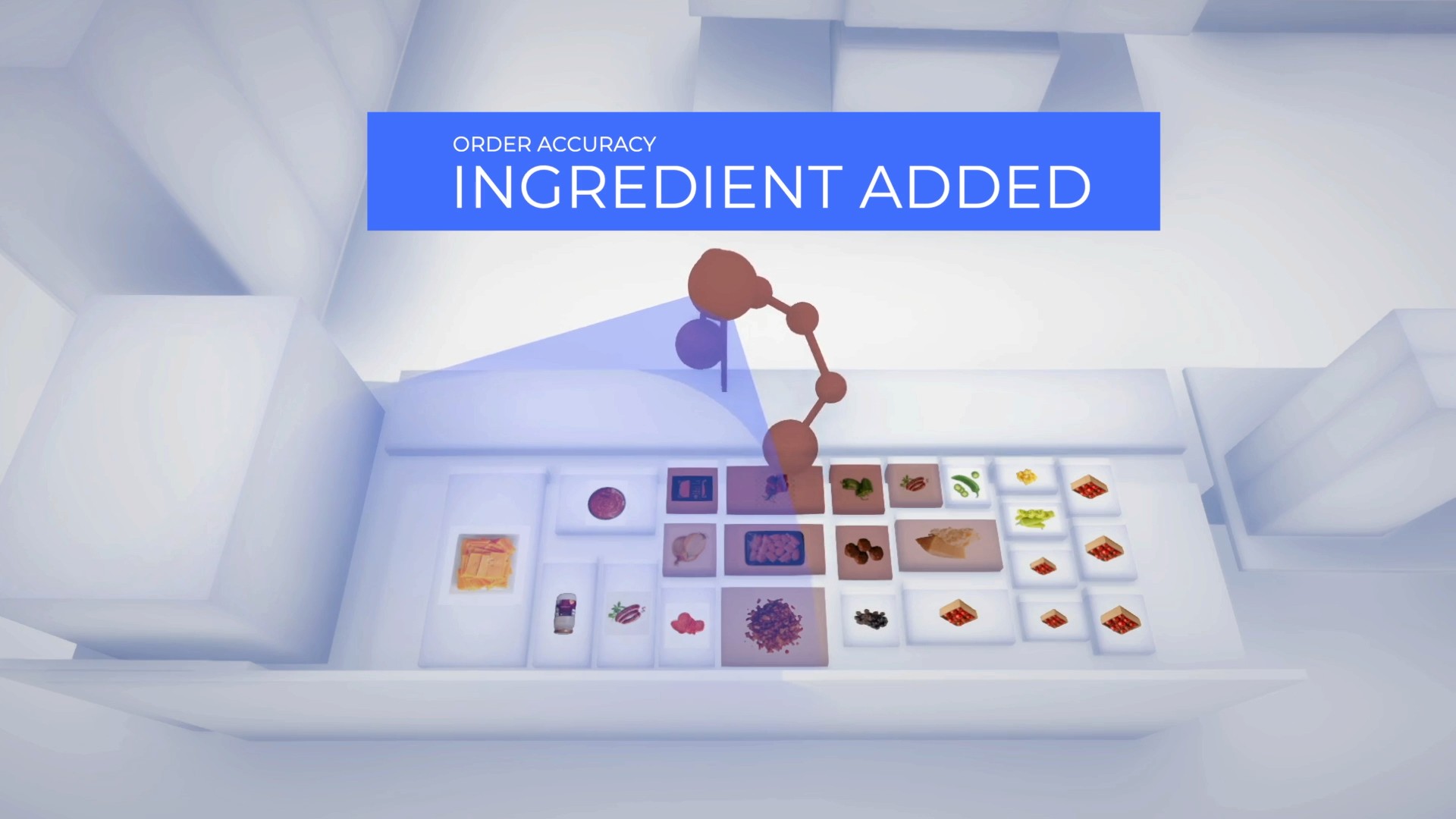
This is where spatial intelligence introduces a different level of clarity. By using existing camera infrastructure, it becomes possible to reconstruct the order assembly process as a continuous sequence of interactions across the physical space. The system observes what actions take place, in what order, and where deviations from the expected flow occur.
AiFi's approach brings together two behavioral domains to enable this view. Sequence and Progression tracks how an order moves through the environment, while Interaction captures what happens at each step along the way. Together, they provide a structured understanding of the process without requiring any input from employees. There are no wearables, no additional sensors embedded in equipment, and no extra steps introduced into the workflow. The system works by observing what is already happening and identifying where it diverges.
This distinction is important because it separates detection from disruption. Other approaches can indicate that something is wrong, but they often lack context. Weight-based verification, for example, can signal that an item is missing, but it cannot identify what was missed or where in the process the deviation occurred. Video review can provide that context, but only after the fact, once a complaint has already been filed.
In both cases, the response is retrospective. Real-time, spatially resolved detection shifts that response forward. It allows the system to surface a potential issue while it is still correctable, without interrupting the flow of work or adding friction to the employee's process. The objective is not to audit behavior, but to provide timely awareness at the moment where a small adjustment prevents a larger outcome.
The impact of that shift extends beyond accuracy alone. Fewer errors mean fewer re-fires, which directly reduces labor costs. Refund volume decreases, improving margins. Customer service teams spend less time resolving issues, lowering operational overhead. Most importantly, customers receive the experience they expect, which influences whether they return.
Even modest improvements can compound quickly. In a high-volume quick-service environment, a five percent increase in order accuracy is often enough to offset the cost of the system within months. Beyond that point, the gains extend into other areas of the operation, creating capacity that can be applied elsewhere.
To understand whether those improvements are taking hold, the metrics must reflect the process, not just the outcome. Order error rate by station provides insight into where issues originate. Error rate by item category highlights which components are most at risk. Re-fire rates, refund rates by order type, and cost per error quantify the operational and financial impact. Time to detect an error compared to time to resolve it reveals how quickly the system responds, while overall accuracy improvement shows how performance changes over time.
Together, these measures shift the conversation from individual accountability to system performance. They make it possible to understand not just that errors are happening, but why they are happening and how they can be reduced without increasing pressure on the people doing the work.
Reframing order errors as a function of cognitive load changes where solutions are found. When mistakes are treated as carelessness, the response is to correct behavior. When they are understood as a product of the environment, the response is to redesign the system so that it supports consistent execution, even under pressure.
In a busy restaurant, the question is not whether employees know what to do. It is whether the system makes it possible to do it reliably when everything is happening at once.