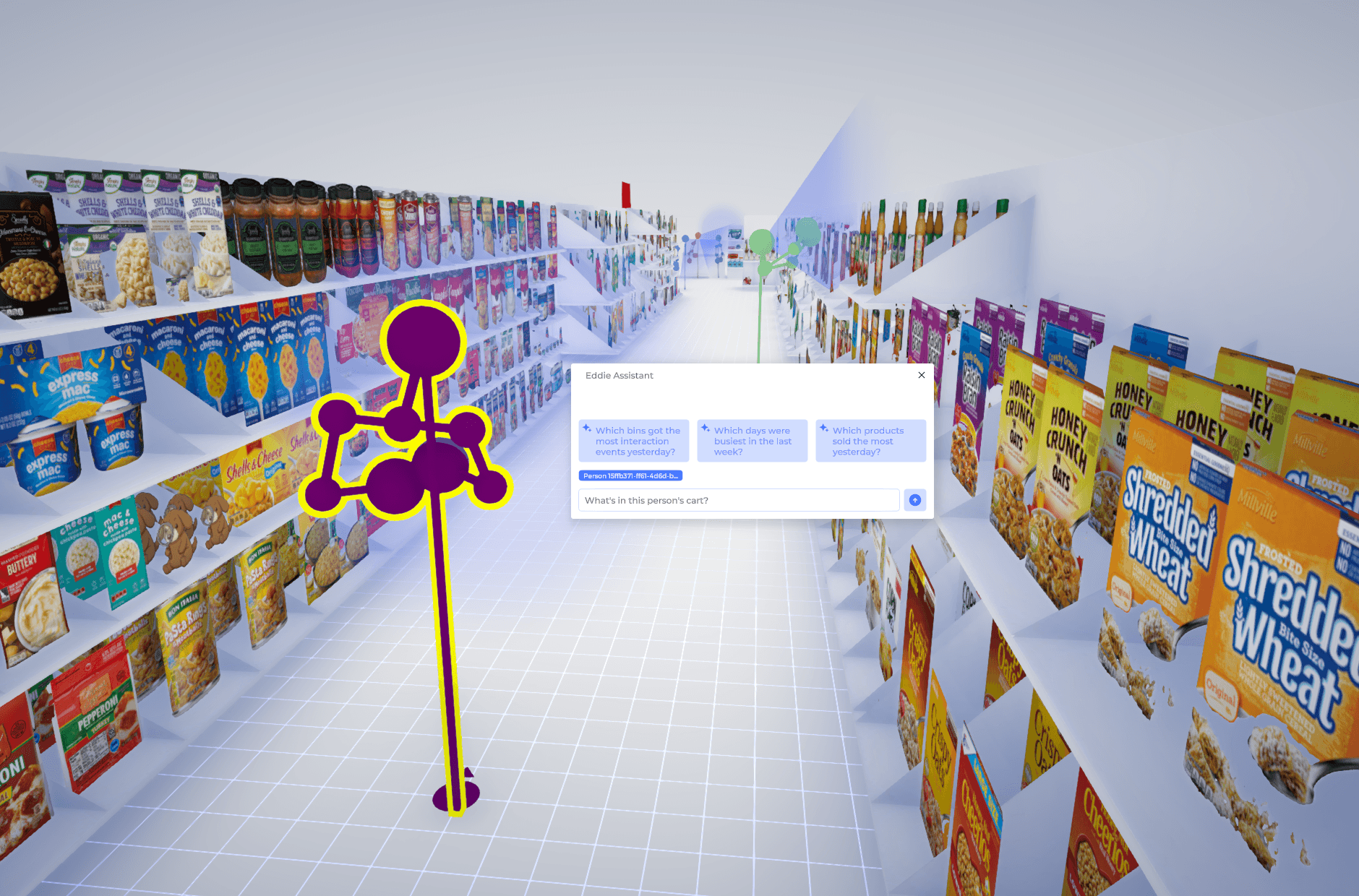
Most operators already have the pieces: a point-of-sale system, a people counter at the entrance, an inventory platform updating overnight. Each one answers a narrow question well enough on its own, but none of them can show how those answers connect into a single, real-time picture of what is happening in the physical space. Understanding the physical world is the layer that ties every existing signal together, and it no longer requires another six-month integration project to get there.
You already understand half your business
Most operators are not starting from zero. They have POS data that tells them what sold. Survey responses that tell them what customers said, after the fact. Online orders that show digital demand. Loyalty programs that track repeat visits. Foot traffic counters that confirm people walked in.
These are real signals. They answer real questions. But none of them capture what actually happened in the physical space: where attention pooled and where it died, what behavior preceded the sale that did not happen, how staff deployment shaped throughput at 2pm versus 6pm, where loss occurred upstream of the register.
That is the gap. Not a lack of data, but a lack of the right context. The physical world has been the missing half of the operator's understanding, and without it, every other data source is incomplete. POS tells you the outcome. It does not tell you the story that produced it.
eddie closes that gap, not by pulling from POS or surveys, but by providing structured, model-agnostic behavioral data from the physical world that those sources have always lacked. The question then becomes: how do you tie it all together? That's where the operator's existing orchestration layer comes in. eddie is built to feed into the tools teams already use. In Microsoft's ecosystem, that means Copilot, as detailed in Microsoft's own customer story on AiFi's Azure deployment, which pulls eddie's spatial intelligence together with POS data, survey responses, online orders, and loyalty programs into a single, natural-language-accessible view. The result is not another data source alongside the others. It is the context that makes all of them coherent. And because eddie's output is structured and model-agnostic, the same integration pattern works across cloud providers and AI platforms.
Ask eddie
The hardest part of any new data capability is not generating the data, it is making it accessible where decisions actually happen. eddie is designed around that principle. Its output is structured, queryable spatial intelligence that integrates into the operator's existing stack, whatever that stack is.
eddie is model-agnostic by design. The platform generates behavioral context from existing camera infrastructure and delivers it as structured data that any orchestration layer can consume. It fits into existing agent stacks, analytics pipelines, and AI assistants without requiring operators to adopt new tools or new workflows.
eddie fits into existing user flows and agent stacks. It can be configured to provide historic spatial data for analytics reviews, or proactive real-time alerts from the physical world, surfacing what matters before anyone has to ask. AI companions like Microsoft Copilot then unifies eddie's context with the operator's other data sources, so every answer reflects the full picture. Rather than adding another dashboard to check, the combination works as a true co-pilot for the physical world: eddie provides the eyes, Copilot brings it all together, and the people on the floor can focus on the customer instead of the screen.
The setup starts with the questions the operator wants answered and the value propositions that matter to their business. Those map to the camera infrastructure already in the space. From there, it is as simple as asking.
Proof at enterprise scale
Across retailers, stadiums, and airports, AiFi analyzes more than sixty million human interactions every month. Clients see twenty-five to forty percent reductions in shrink, throughput in venues increasing up to three hundred percent, and decision latency dropping from weeks to seconds. At the store level, precision shows up in 99%+ receipt accuracy over 15.4 million journeys and in off-hours sales that meaningfully change store economics.
Seconds-to-signal changes the economics
When the system can answer a question in seconds, which zone is starving dwell today, where queue formation is beginning, whether a planogram is earning attention, the action loop compresses. Operations rebalance staff in the moment. Merchandising fixes the shelf this week, not next quarter. Loss prevention intervenes upstream of shrink. The operator stops staring at dashboards and starts spending time with customers, because eddie is watching the space for them.
The right question
The decision is not which checkout tool to deploy. It is whether your enterprise will own the missing context from the physical world, the behavioral intelligence that makes all your existing data coherent, delivered by eddie, unified by Copilot alongside the sources you already trust, activated through the tools your teams already use.