The New Marketing Funnel Is Physical: Exposure, Attention, Interaction, Basket
Published
Tags
Post
Retail has always had a marketing funnel. It just hasn’t been measured like one.
For decades, teams have designed displays, negotiated endcap placement, launched seasonal campaigns, and introduced new products with a clear expectation of how shoppers would respond. Visibility would drive awareness. Awareness would lead to engagement. Engagement would convert to purchase.
The structure has always been there. What’s been missing is the ability to observe it as it happens.
In digital channels, every stage of the funnel is instrumented. Teams know how many people saw an ad, how many engaged, and how many converted. In physical stores, that same journey plays out every day, but most of it remains invisible. Performance is judged by sales outcomes and store feedback, often reduced to a general sense of what seemed to work.
That lack of visibility makes it difficult to diagnose what’s actually happening on the floor. It also makes it difficult to improve.
Defining the Physical Funnel
The customer journey inside a store follows a sequence, even if it is not always captured explicitly. It can be broken down into four stages:
Exposure occurs when a shopper has a clear line of sight to a product or display. The item is physically present in their field of view, creating the opportunity for engagement.
Attention is the moment when that opportunity turns into focus. The shopper notices the product, signage, or display in a way that captures their awareness. This is distinct from proximity. A shopper can pass by a display without ever registering it.
Interaction is the next step, where the shopper takes an action. They pick up the product, inspect it, compare it to alternatives, or place it back on the shelf.
Basket represents the outcome. The item is either added to the purchase or removed from consideration.
This sequence is familiar in digital contexts, but it has rarely been applied with the same clarity to physical environments. Without these distinctions, it becomes difficult to understand where a campaign is succeeding or failing.
Where Most Campaigns Actually Break Down
When performance is evaluated only at the point of sale, all upstream signals are lost. A campaign that underperforms could be failing for several different reasons, but they appear identical when viewed through a single metric.
A display might not be visible enough, resulting in low exposure. It might be well placed but fail to capture attention due to ineffective creative. It might draw attention but fail to drive interaction because the product or messaging does not resonate. Or it may generate interaction without converting to purchase.
Each of these scenarios requires a different response. Without a structured funnel, they are difficult to distinguish.
By separating the journey into stages, the problem becomes diagnosable. Teams can identify whether the issue lies in placement, creative, product-market fit, or pricing. The conversation shifts from whether something worked to where it broke down.
Making the Physical Funnel Measurable
The challenge has always been visibility. Unlike digital channels, physical stores do not inherently track exposure or attention. They capture transactions, but not the sequence that leads to them.
This is where spatial intelligence introduces a new layer of measurement.
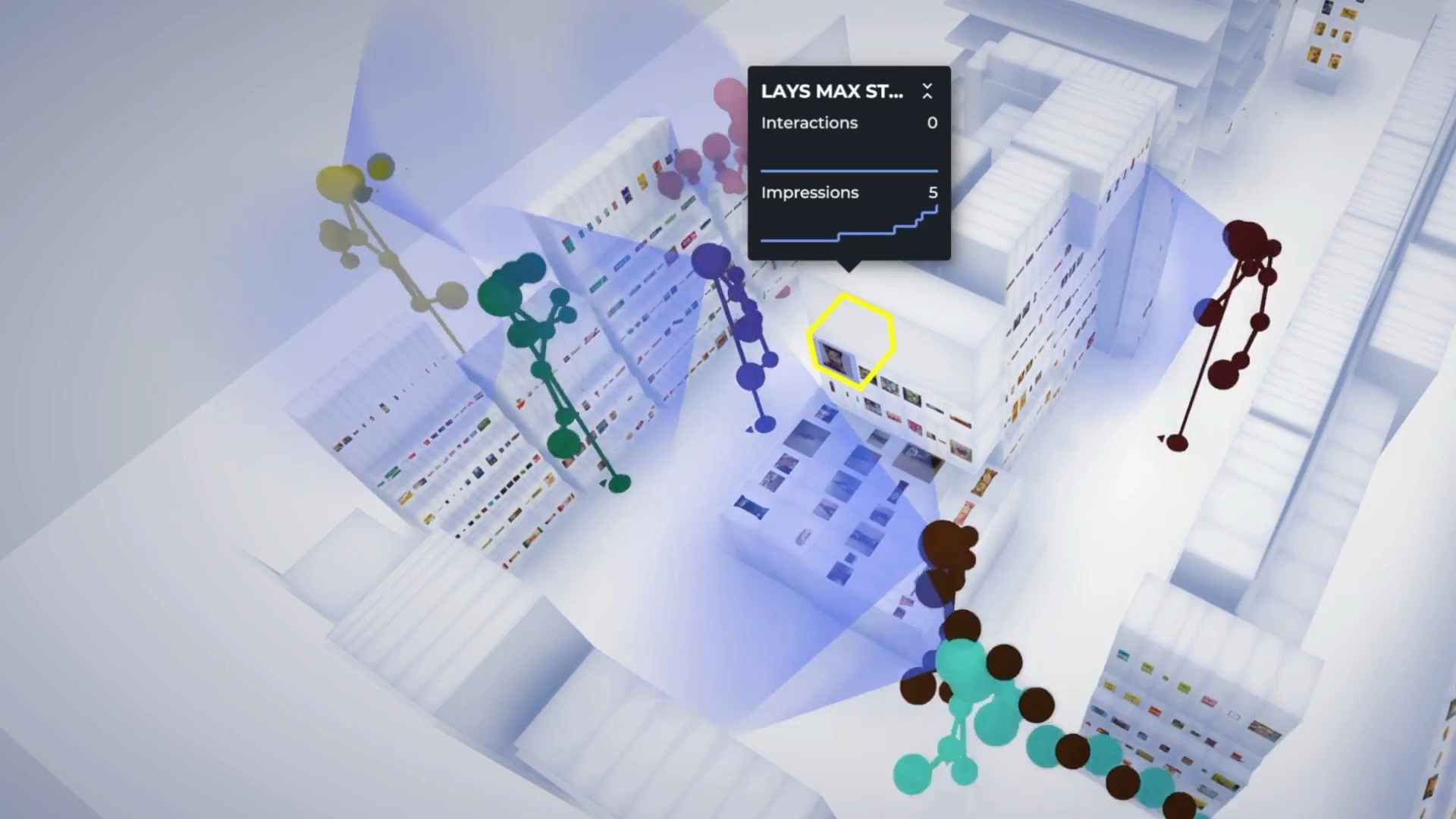
AiFi’s platform uses computer vision to understand how shoppers move through space and interact with products. Because the system reconstructs the environment in 3D and maintains awareness of position and movement, it can determine when a shopper has line of sight to a display, when their attention is directed toward it, and when they physically engage with the product.
These signals make it possible to quantify each stage of the funnel without requiring any input from the shopper or additional hardware in the store. The same system that powers autonomous retail and real-time operational insights can be applied to marketing performance, using existing camera infrastructure.
What was previously inferred can now be observed.
From Measurement to Experimentation
Once the funnel is visible, it becomes possible to test and refine it.
In digital marketing, experimentation is routine. Creative is adjusted, placement is optimized, and performance is measured against a baseline. The same approach can be applied to physical environments when the right signals are available.
A retailer might change the design of a display, adjust its placement within the store, or update pricing and signage. The impact of those changes can then be measured across each stage of the funnel. Does exposure increase with a new location? Does attention improve with different creative? Does that attention translate into interaction and ultimately into purchase?
Because each stage is measurable, the effect of a change can be isolated. Teams can see not just whether performance improved, but how and why it improved.
This creates a feedback loop that has historically been missing from in-store marketing.
Where This Applies Today
The physical funnel is not limited to a single type of activation. It applies across a range of in-store scenarios where visibility and engagement matter.
Endcaps are a common example, where placement and design are intended to capture attention in high-traffic areas. Seasonal displays and new product launches rely on similar dynamics, often with limited time to prove effectiveness. Price signage and in-store media introduce additional variables, where messaging and positioning influence how shoppers respond.
In each case, the same questions apply. Did shoppers have the opportunity to see it? Did they notice it? Did they engage with it? Did that engagement convert?
The funnel provides a consistent way to answer those questions across different contexts.
Metrics That Reflect the Full Journey
With these stages defined, the metrics become more precise.
Exposure rate measures how often shoppers have line of sight to a display. Attention rate captures how often that exposure leads to awareness. The transition from attention to interaction reflects how compelling the product or messaging is, while interaction-to-basket conversion shows how often engagement results in purchase.
These can be compared against baselines to understand lift, and analyzed with confidence intervals to determine whether observed changes are meaningful.
Together, they provide a view of performance that extends beyond sales alone. They show how behavior changes within the store, and how those changes contribute to outcomes.
A Different Starting Point for In-Store Marketing
For years, physical retail has operated without the same level of attribution that digital channels take for granted. Campaigns are executed, results are observed, and conclusions are drawn with limited visibility into the underlying behavior.
The physical funnel changes that starting point. It introduces a shared framework for understanding how shoppers move from exposure to purchase, and a set of measurable signals that reflect each step along the way.
The goal is not to replicate digital marketing inside the store. It is to bring the same level of clarity to a different environment, one where behavior unfolds in space rather than on a screen.
When that clarity exists, the conversation shifts. Instead of asking whether a campaign worked, teams can ask where it worked, where it didn’t, and what to change next.
And for the first time, those answers can be grounded in what actually happened on the floor, not just in what showed up at the register.