By Sebastian Herforth
Walk into almost any QSR and you’ll see cameras mounted above the counter, over the make line, near the drive-through window. Some operators have invested heavily in visibility, while others haven’t at all; regardless, they’re all flying blind when a rush hits.
POS tells you what sold. Cameras record what happened. Neither tells you what is happening right now; where the bottleneck is forming, whether confusion started at the kiosk, or if the pickup window is about to stall.
That gap is where revenue slips away.
The Real Problem: You’re Managing Lagging Indicators
Most operators know their outcomes. They track ticket times, refunds, complaint rates, and speed of service. Those metrics matter, but they’re lagging indicators. By the time ticket time spikes, the damage has already started.
And ticket time itself is a compound number. It blends together order complexity, station capacity, staff coordination, and customer behavior at pickup. When it increases, you don’t know whether the grill fell behind, the handoff broke down, or lobby congestion slowed everything downstream. They’re often left relying on surveys for answers, which offer delayed, subjective signals rather than a clear view of what actually broke down in the moment.
Without disaggregating that number, you’re left diagnosing symptoms instead of causes.
What Your Cameras Can Actually Tell You
The irony is that much of the insight already exists in the physical space. When understood correctly, existing cameras can reveal operational signals in real time.
For example:
Live queue depth across drive-through, counter, and kiosk
Dwell anomalies in the lobby, including customers who appear unsure where to go
Delays between make line completion and pickup handoff
Imbalances between aggregator pickup flow and dine-in traffic
Order accuracy risks before handoff
Pickup delays and unacknowledged customers
A queue build-up that triggers abandonment can form in under three minutes. The intervention window is short. The difference between reviewing footage tomorrow and adjusting staffing right now is the difference between lost revenue and protected throughput.
Scaling the Instinct of a Great Manager
Experienced shift managers develop an intuition for these moments. They can feel when the line is about to stall or when the lobby is turning chaotic. But instinct does not scale, and it doesn’t cover every angle of the floor at once.
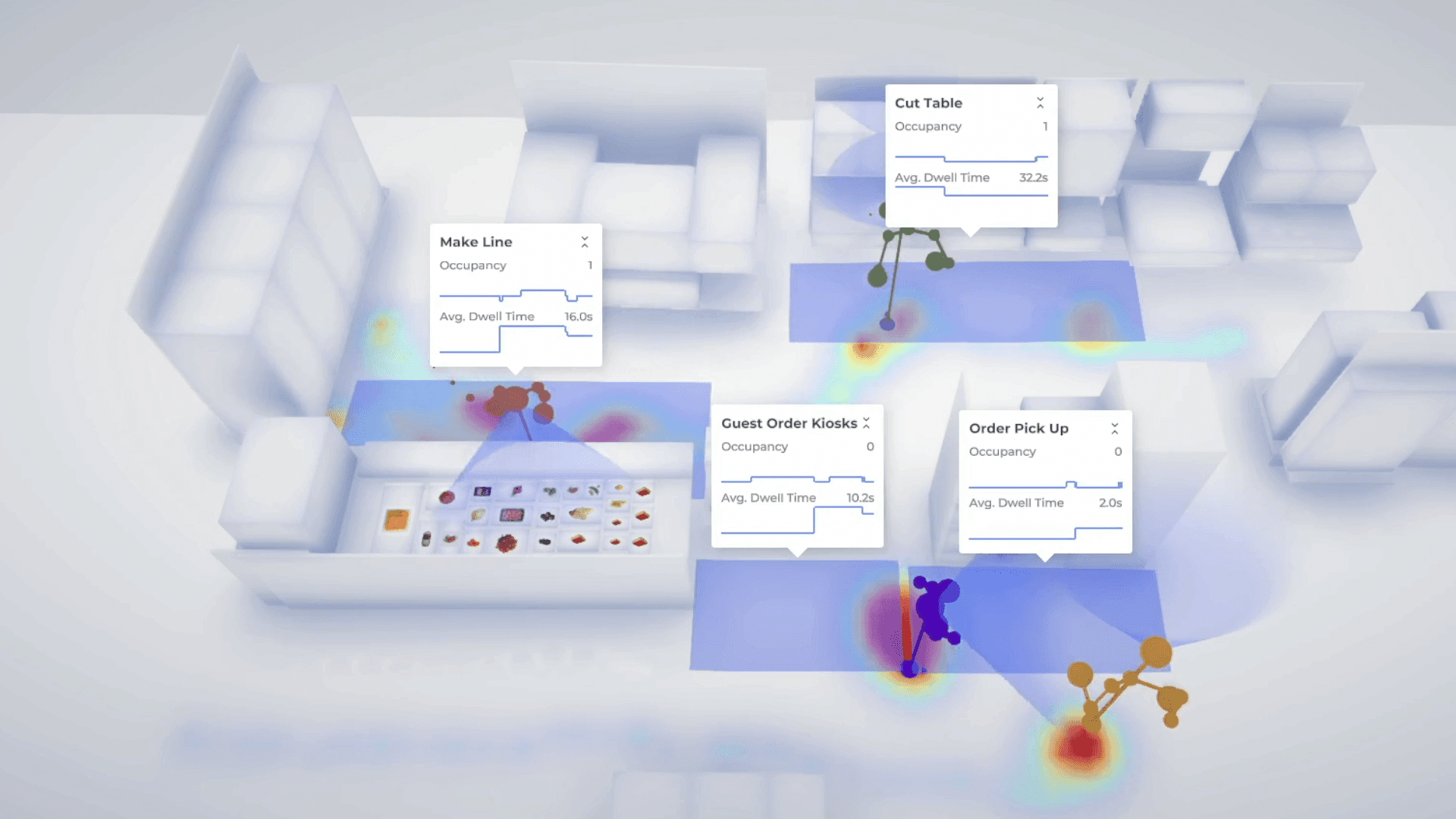
Spatial intelligence turns that instinct into a system. It uses the cameras already installed, recreates the physical environment in 3D, and layers behavioral context on top. No new hardware. No sensor overlays. The difference isn’t the lens; it’s the intelligence applied to what the lens already sees.
With that layer in place, you can identify a prep problem versus a handoff problem. You can detect when staffing needs to shift between drive-through and dine-in. You can see confusion forming at a digital kiosk before it shows up in refund volume.
Why This Changes the Business
When you can see your operation as it unfolds, you move from reactive management to real-time control. Intervention windows become actionable instead of theoretical.
Every prevented abandonment is recovered revenue, every bottleneck resolved mid-rush protects capacity, and every incorrect order caught before it reaches the guest increases the likelihood they return.
The goal is to gain clarity. It is giving the shift manager a second set of eyes that never leaves the floor, and a subtle co-pilot that helps the team adjust in the moment. Instead of surfacing issues after the fact, it guides attention toward what matters while there is still time to act, so teams can stay focused on the customer and the work that drives the most value.
At the same time, that visibility doesn’t stop at a single location. When applied across a network of stores, it creates a shared view of how operations actually run day to day. Patterns that were previously invisible begin to surface. High-performing locations can be understood in concrete terms, and their practices can be replicated across the rest of the fleet. Standards rise not through enforcement, but through clarity.
The question is no longer what went wrong yesterday. It’s whether you can see what’s happening right now, and act while it still matters.
Talk with our team about spatial intelligence for restaurant operations.